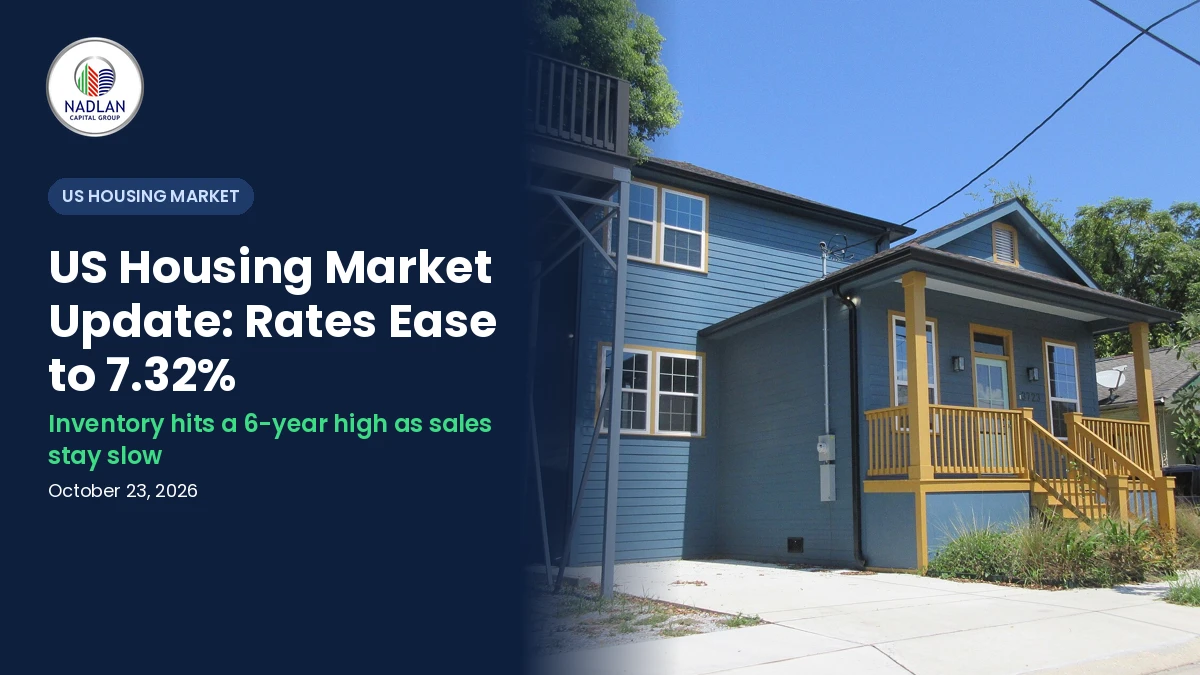
Rates Ease, Inventory Hits a Six-Year High
Kribel helps property owners run the numbers and manage their rentals with a clear head when the market sends mixed signals — kribel.com
Every topic on this blog — including this one — can be explored with our professionally crafted AI Insights and discussed in depth in your anonymous, encrypted community chat. Join Kribel to use these features!
Rates easing to 7.32% and inventory at a six-year high is leverage for patient owners, not a buy signal. Underwrite deals at today's rate, negotiate hard, and don't refinance unless the math clearly works.
The news in one line
Mortgage rates just slipped for the first time in two months while the number of homes for sale climbed to a six-year high — and it is tempting to read that as a green light to go buy. We would pump the brakes on that instinct.
What actually happened
The average 30-year fixed rate fell to 7.32% for the week ending October 22, down from 7.40% a week earlier but still well above the 6.19% average of a year ago, according to Nadlan Capital Group. It was the first decline since late August, arriving after seven straight weekly increases that had pushed rates up roughly 74 basis points in just over a month. The bond market moved further: the 10-year Treasury yield, which mortgages track more closely than the Fed's own rate, fell below 5% for the first time since September 23.
The bigger story sits on the supply side. Homes for sale rose to 1.60 million, up 4.6% from a year ago and the highest level since November 2019 — about a 4.8-month supply. Yet demand is soft. Existing-home sales edged up 1.5% in September but remained 2.2% below last year, and signed contracts fell 7.3% to the lowest reading on record, with roughly 14.5% of deals under contract falling through. The median existing-home price was $417,500, up just 1.3% from a year earlier.
Builders feel it too. Housing starts fell 5.2% in September and builder confidence dropped to 29 in October, its lowest since 2012, with about 43% of builders cutting prices.
Meanwhile, Forbes Advisor reports the Fed raised its benchmark a quarter point in September, putting the federal funds rate at 3.75% to 4.00%, and notes rates had been sitting around 7.5% in October. In an October HousingWire poll of mortgage executives, about 70% expected rates to hold steady or rise over the next six months; only around 30% saw them easing toward 7%.
Our take
Here is the trap we want owners to sidestep: "rates easing plus inventory climbing" sounds like a starter's pistol. It isn't. The very slack that makes it easier to buy — more listings, longer days on market, more canceled contracts — is the same slack that softens buyer competition if you are the one selling. One number tells the whole story: signed contracts hit a record low. That is a market cooling, not catching fire.
An 8-basis-point dip also does not rescue a deal that doesn't work at 7.3%. Most of the autumn run-up is still baked in, and the people who forecast rates for a living are split, leaning toward "higher for longer." As Forbes puts it, most experts caution against waiting for a rate you like better before you act — which cuts both ways. Don't buy on the hope of a future cut, and don't sell in a panic that rates will never improve.
A six-year inventory high is leverage for patient owners, not a reason to rush. The opportunity is disciplined, not frantic.
What this means for you as an owner
- If you're thinking of acquiring, underwrite at today's rate. Make the numbers work at roughly 7.3%. Any future rate drop is upside, never the plan. With inventory at a six-year high and more than one in seven contracts collapsing, sellers are motivated — so negotiate on price, repair credits, or a seller-paid rate buydown. This is a buyer's moment precisely because it is not a frenzy.
- If you're thinking of selling, respect the clock. Days on market are stretching and buyer competition is thinner. Price to the market you're in, not the one you remember from two years ago, and assume a realistic timeline. A record low in signed contracts is not the backdrop for a quick, over-ask sale.
- Run the refinance math — carefully. Forbes notes many lenders say a refinance only pays off when you can cut your rate by at least a full percentage point, and closing costs mean you need to stay long enough to recoup them. With 49.1% of outstanding mortgages below 4%, most owners are better off staying put and holding that cheap debt than chasing a refinance that doesn't clear the math.
- Shop your financing hard. Freddie Mac data cited by Forbes found buyers saved roughly $3,000 over a loan term by getting five quotes instead of one. On an investment purchase, that discipline compounds.
- Think past 2026. Starts are falling and builders are pulling back, which can tighten supply in 2027 and 2028 in markets with real job and population growth — a quiet tailwind for rents and values if you hold.
The bottom line
This isn't a signal to expand or to exit. It's an invitation to be deliberate. The owners who do well in a slack market are the ones who know their numbers cold, move when a specific deal clears their math, and ignore the FOMO on both sides. Patience, right now, is the strategy.
Your questions, answered
Do easing rates and rising inventory mean now is the time to buy another rental?
Only if the deal works at today's rate. The 30-year fixed eased to 7.32% for the week ending October 22, but that is still well above the 6.19% of a year ago, and most of the autumn run-up remains. With inventory at a six-year high and sellers motivated, it can be a good moment to negotiate price and terms — but underwrite at roughly 7.3% and treat any future rate drop as upside, not the plan.
Should I refinance now that rates have dipped slightly?
Probably not on an 8-basis-point dip. Forbes notes many lenders say a refinance only makes sense when you can cut your rate by at least a full percentage point, and closing costs mean you need to stay long enough to recoup them. With 49.1% of outstanding mortgages below 4%, most owners are better off holding their cheap existing debt.
Is it a good time to sell a property right now?
The data points to a cooling, buyer-leaning market. Signed contracts fell 7.3% in September to a record low, roughly 14.5% of deals under contract fell through, and homes for sale hit a six-year high. If you sell, price to current conditions and plan for a longer timeline rather than a quick over-ask sale.
Kribel Here To Help
How Kribel helps with today's topic
When the market turns slack, discipline beats instinct — and that is where clear numbers help. Kribel gives property owners one organized place to track income, expenses, and performance across their rentals, so you can tell at a glance whether a potential deal actually clears your math at today's rates. Explore how it works in our live demo, or see what we build for owners who want to make deliberate, grounded decisions rather than chase headlines.
How Kribel helps owners and tenants every day
Kribel brings everything a rental needs — properties, tenants, leases, maintenance, vendors, documents, and payments — into one elegant, private home, with an owner community chat where real owners trade real answers. Owners run the whole portfolio from a single dashboard; tenants get a clear, respectful space of their own. Step inside the live demo or start at kribel.com.
What makes Kribel different
Most property software is a spreadsheet with a login. Kribel stands on pillars competitors simply don't have: privacy-first architecture that treats your data as yours alone, a private owner community chat, concierge-grade service that feels like a members' club, and one platform built for owners, tenants, and partners together. See the difference in the demo — then make yourself at home.